Analysis: Why we shouldn’t tiptoe around who is at highest risk for monkeypox infection


The Biden administration this month declared an outbreak of monkeypox, a virus spreading disproportionately among men and men who have sex with their sexual networks, a public health emergency.
Not wanting to reproduce the anti-gay stigma seen during the early AIDS crisis, some Argue Clarifying which group is most at risk for monkeypox infection can be dangerous.

Yet experts say the emphasis on normalizing warnings affects access to the most vulnerable, including black and Latino men, and overshadows the lessons of the AIDS crisis, which highlighted the importance of combating stigma. And Trying to take care of those who need it.

“We don’t want to add stigma to a delicate situation, but then our message gets so broad that no one knows who we’re talking to—and that becomes a real problem,” says Robert Fullilove, clinical Professor of Social Medical Sciences at Columbia University Medical Center told CNN.

In short, experts say we shouldn’t balk around on the issue. Instead, we must confront it directly, and look towards increasing access to care.

What do the initial figures show

Part of the point of talking about monkeypox in an indirect way is that we end up putting more emphasis on who can do get the virus and reduce who does Get it, according to Atlanta-based HIV physician and researcher Melanie Thompson.

Take a detailed look at monkeypox case records published this month by the US Centers for Disease Control and Prevention. Anyone can get the virus, yes, but a CDC analysis shows that 94% of cases were in men who had recently had sexual or intimate contact with another man. In addition, 54% of cases were in Black Americans and Latinos.
Preliminary data from the Georgia Department of Public Health and the North Carolina Department of Health and Human Services show a similar pattern: In both states, monkeypox is overwhelmingly affecting black men.

Thompson underscored the importance of clarity, of communication that explains where the virus is headed.
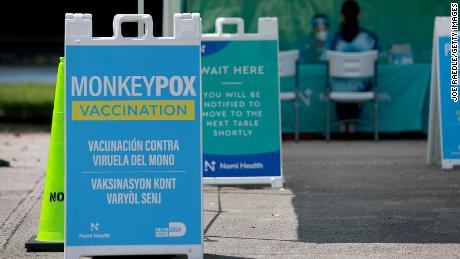
A sign announcing monkeypox vaccination is installed in Tropical Park by Miami-Dade County and Nomi Health, August 15, 2022.

“The purpose of the data is not just to crunch numbers – but to ensure that those most affected by monkeypox or any other disease entity are getting essential services,” she said.

See also  California battles East Coast pizza rivals for top spot in new national ranking

“The message that anyone can get monkeypox spreads fear among the general population. It distracts from the message we need to get to people at risk of contracting monkeypox,” Thompson said.

And such convulsions don’t just distract. It’s marginalized in a different way, she said.

Jim Downs, an epidemiological historian at Gettysburg College and author of “Ladies of Empire: How Colonialism, Slavery and War Transformed Medicine,” echoed some of Thompson’s sentiments.

“The evidence shows that men who have sex with men are at greater risk than any other population or group,” he said. “So when we talk about directing messages and, most importantly, vaccines, we need to make sure those efforts are intentionally targeting people at highest risk, who People might think, ‘Well, why not get vaccinated? It’s just a good idea.'”

It’s worth underlining that, while most cases of monkeypox occur in black men, it’s not because they’re black, experts say.

Fullilov said, “When we use race as a way of identifying an important characteristic of a sick person, some people think that race is biologically active – something about brown skin. who are more likely to be infected with monkeypox.” “But that’s not the case. What we’re seeing is the dynamic of who hangs out with whom and where they socialize.”

Thompson also inserted a note of caution in the conversation.

“There is no racial propensity for monkeypox,” she said. “It has to do with structural racism and the nature and cultural practices of communities.”

She said that Georgia, for example, is still very different based on race and sexuality.

“This means that people who are black are more likely to have sexual partners who are also black,” Thompson explained. “And because they are a small proportion of the population, the chances of being exposed to the virus are high.”

See also  Park Slope Food Coop passes controversial Israel boycott in divisive, chaotic meet attended by over 7K members

If there is a silver lining, it is that monkeypox should be easier to prevent and eradicate as we have a more solid understanding of where the bulk of the infections lie.

‘AIDS activism wasn’t just about saying the right thing’

The push by some for generalized monkeypox messaging is based on good intentions, and attempts to address the brutal anti-gay stigma seen during the AIDS crisis in the 1980s and ’90s.

Yet that approach strips the term of some of its complexity.
“I think it’s a very worthwhile effort not to contribute to the anti-gay stigma. A lot of people have a broader understanding of how it works in the context of the early AIDS epidemic. I don’t think it’s necessarily a subtle one. There is an understanding of how it happened, but there is an awareness that it happened and a feeling that we shouldn’t do it again,” said Dan Royals, an associate professor of history at Florida International University and “To Make the Wounded Hole”. author of: The African American Struggle Against HIV/AIDS,” told CNN, adding that all this is happening in the context of a right-wing attack on LGBTQ rights.
The royals said the ambitions of AIDS activists were huge; They went beyond the realm of messaging.
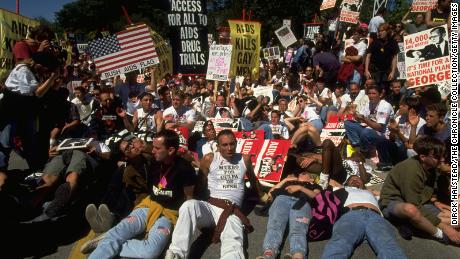
Members of ACT UP in Kennebunkport, Maine, protesting then-President George H.W. Bush's AIDS policy, September 1, 1991.Members of ACT UP in Kennebunkport, Maine, protesting then-President George H.W. Bush's AIDS policy, September 1, 1991.

“AIDS activism was not just about saying the right thing,” he explained. “It was about taking care of those who needed it.”

Consider some of the work of ACT UP (AIDS Coalition to Unleash Power), an organization fighting AIDS. On May 21, 1990, more than 1,000 protesters stormed the National Institutes of Health in Bethesda, Maryland. Their purpose: to urge the NIH to fix what activists saw as the glacial pace of AIDS research and treatment efforts.
In other words, facing the government’s inadequate response to the pandemic, activists took matters into their own hands and fought for a more humane healthcare system. (Notably, present-day queer communities are doing something similar, as they grapple with the state’s sluggish efforts to combat monkeypox.)

It’s not meant to downplay the value of a careful, sympathetic message.

See also  Dog born with second penis on his leg undergoes surgery for ultra rare birth defect

Thompson thinks there is a high level of stigma attached to monkeypox. She said physicians are hearing from some patients that they are ashamed of having the virus.

Complicating matters further, he said, is the fact that there are care providers who don’t want to see people with monkeypox – meaning people with the virus have less room to get treated.

Clearly, the message isn’t that of shame, and is partly influencing the ongoing debate about whether to call monkeypox a sexually transmitted disease, as my CNN colleague Jacqueline Howard recently reported.
Still, the royals’ deep point is important. As we continue to face monkeypox, we should not lose sight of the fact that the main goal is to broaden access to care.

“Our politics often boils down to debate over discourse and messaging, divorced from the physical reality of people’s lives,” Royals said. “Not unlike HIV and AIDS, monkeypox has significant physical consequences for your body if you get it. It’s so tangible that it’s deeply ironic that so much of the conversation is focused on discourse, which is districtembodied in many forms.”

or as Joseph Osmondson, clinical assistant professor of biology at New York University, The difficulty of accessing care is aptly summarized“You can’t send a message to an infectious disease. We need tests, treatments and vaccines, none of which came on time.”


(This story has not been edited by seemayo staff and is published from a rss feed)

Leave a Comment