
newYou can now listen to Fox News articles!
The COVID-19 virus isn’t the only virus on the minds of college students as they head back to school this fall. Students will also have to deal with strategies to prevent possible transmission of the monkeypox virus.
“Monkeypox is still shrouded in a lot of mysteries. An important point is that it is not a traditional sexually transmitted virus,” said Michael S. Kinch, dean of science and director of the Center for Research Innovation in Biotechnology. Brookville, NY. at the University of Long Island in
Kinch also told Fox News Digital, “The pathogen can be transferred through sweat and therefore, any type of body contact could, in theory, result in transmission.”
Monkeypox: What you need to know about the virus—and how to protect yourself
He also added, “One can easily predict that the risk of monkeypox will be significantly higher once college and high school resume.”
Some college students told Fox News Digital that they were terrified of another virus affecting their region of the country.
Today some people are wondering about monkeypox and how they need to be aware to keep themselves safe from infectious disease.
(Reuters/Rebecca Noble/iStock)
A New York University (NYU) student says she is a little nervous about monkeypox as she attends a school in the city, which is reporting the highest number of cases in the country.
She said she finds it comforting to know that a vaccine is available.
Another student who attended SUNY Stony Brook this fall said she’s going to be more careful about who she “hangs out with.” She also said she hopes colleges will provide more information about the virus and services to students when the school year begins.
Shared space means more care is needed
College students typically congregate in shared spaces such as classrooms and dorm rooms, and at parties.
The start of the sports season will also encourage physical contact between the student athletes.

As college semesters begin, students are realizing they need to take smart precautions against the monkeypox virus.
(iStock)
Infectious disease experts told Fox News Digital that while infectious diseases are part of society, that doesn’t mean people shouldn’t socialize or be around others.
Will monkeypox become an ‘established STD’? Why does an infectious disease specialist think so?
Individuals just have to take certain measures to ensure safety.
“Right now the risk of monkeypox has increased, but that doesn’t mean young people can’t socialize or enjoy their college experience. This will simply change How They do those things, for now, while the risk of infection is high,” said Richard Silveira, MD.
“Limit skin-to-skin contact with people you know or with whom you can discuss your risks and their risks.”
He is associate program director of the Infectious Disease Fellowship and assistant professor of medicine (infectious diseases) at the Icahn School of Medicine at Mount Sinai in New York City.
Silvera listed some strategies that college students can adopt to prevent monkeypox transmission.
Monkeypox Virus Infection at COVID Sites in NYC
He said, “Socialize with social distancing. Limit skin-to-skin contact to people you know or with whom you can discuss your risks and their risks. If you feel unwell – or some is wrong – don’t ignore it. Stay home and take care to make sure you’re okay.”

One expert said it is “extremely important” for college students to “be very careful” about staying safe from infectious diseases.
(AP Images)
Aaron E. Glatt, MD, chair of the Department of Medicine and chief of infectious diseases at Mount Sinai South Nassau on Long Island, NY, told Fox News Digital, “This is extremely important for kids in college — regardless of who they are having contact with. Sharing various objects through a sexual nature or with a roommate who has wounds or is at risk of wounding – to be very careful.”
Glatt said the main way monkeypox spreads is through contact with a person who is contagious and has sores.
One expert said that people who engage in casual sexual encounters with unfamiliar partners are putting themselves at risk of contracting monkeypox as well as other diseases.
He also noted that at this point in time, the majority of cases involve men who have sex with men or often with multiple partners, or in casual encounters.
Glatt cautioned that people who engage in casual sexual encounters with unfamiliar partners are putting themselves at risk of contracting monkeypox, as well as other diseases.
“These patients are most at risk because you don’t know their history, you don’t know if they’re sick or not. [and] You don’t have a relationship with them where you don’t know if they have wounds,” Glatt said.
Why scientists are studying wastewater to learn more about monkeypox, other diseases
So, he adds, “that type of exposure is something that should always be forewarned because of other sexually transmitted diseases or other medical issues that may come up.”
Silver also told Fox News Digital that it is important for college students to “discuss your risks, potential risks, and any skin lesions with whom you will be in intimate contact.”
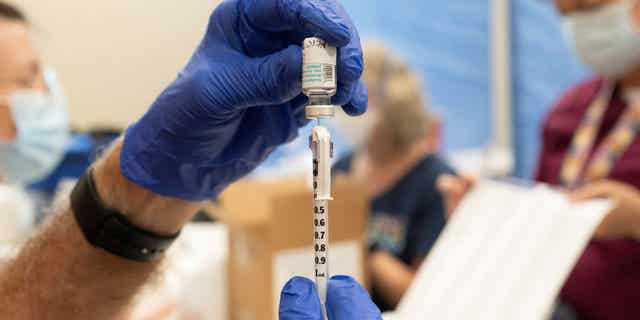
The JYNNEOS smallpox and monkeypox vaccine is pictured here on August 20, 2022 at the Pima County Department of Public Health at the Abrams Public Health Center in Tucson, Arizona.
(Reuters/Rebecca Noble)
In a college dorm, he said, “this can include roommates and lab partners. Most importantly, if you have a new skin lesion and/or aren’t feeling well, stay home!”
“Whether it’s monkeypox, COVID-19 or just the common cold, staying home when you’re sick is one of the best ways to protect those around you.”
Silveira said monkeypox can also be spread through soft objects such as towels, linens and clothing.
“When you do laundry, things should be washed hot (with detergent!).”
Therefore, “to reduce your risk and the safety of those around you, do not share towels, clothing or bed linens. When you do laundry, hot (with detergent!) Items should be washed.”
The infectious disease doctor also recommends wearing gloves and washing your hands after handling unwashed clothing or linens.

“Parents can be reassured that the risk of monkeypox in the general student population is low,” said one emergency doctor.
Dr. Matthew Harris, MD, a pediatric emergency medicine attending physician at Cohen Children’s Medical Center at Northwell Health on Long Island, NY, told Fox News Digital, “There is concern if an infected person has come into contact with linens or clothing. , then it would be prudent for the exposed individual to speak with their medical provider regarding prophylactic vaccination after exposure.”
Harris, director of the COVID-19 Vaccination Program and Northwell Crisis Management, tried to ease the concerns of worried parents and students.
“In general, parents can be reassured that the risk of monkeypox in the general student population is low.”
Dog infected with monkeypox after sharing bed, licking owners
“Most monkeypox cases occur in populations of men who have sex with men, and as such, adolescents or college students who fit into this group should consider appropriate vaccinations and precautions.”
Just this week, the New York State Health Commissioner, Dr. Mary T. Bassett, announced that the monkeypox vaccine would begin to be delivered intradermally (in the middle of the skin) rather than subdermally (under the skin).
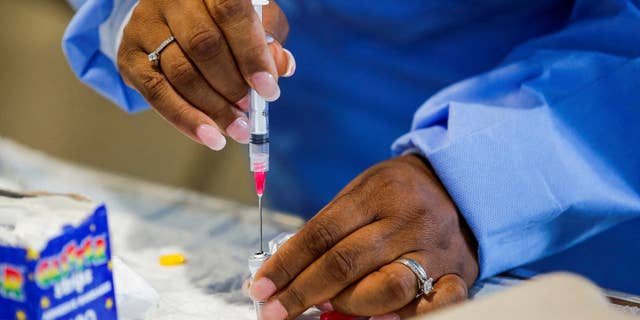
A dose of monkeypox vaccine is loaded into a syringe by a medical worker at Westchester Medical Center on July 28, 2022 in Valhalla, NY.
(Reuters/Eduardo Munoz)
This means that only one-fifth of the dose of the initial monkeypox vaccine would be needed to evoke an effective immune response against the virus.
“Our primary goal is to prevent the spread of this virus by increasing the immunity of most at-risk individuals,” Bassett said in a press release.
She also said, “This latest delivery of vaccine vials from the federal government, given the newly authorized method of administration, will mean more vaccine doses for more people.”
The CDC recommends that anyone who has been exposed to monkeypox be vaccinated.
Currently, the Centers for Disease Control and Prevention (CDC) recommends that anyone who has been exposed to monkeypox be vaccinated.
According to the CDC, monkeypox can be spread through the following issues and actions: Skin-to-skin contact with a person who has a rash or scabs from monkeypox; hugging, hugging, massaging, or close contact sports; drops of saliva during close conversation and kissing; sexual contact; Contact with objects, clothing (clothing, bedding, or towels), and surfaces that have been used by someone with monkeypox.
good care tips
If you come into contact with someone who has monkeypox, the CDC recommends several smart tips.
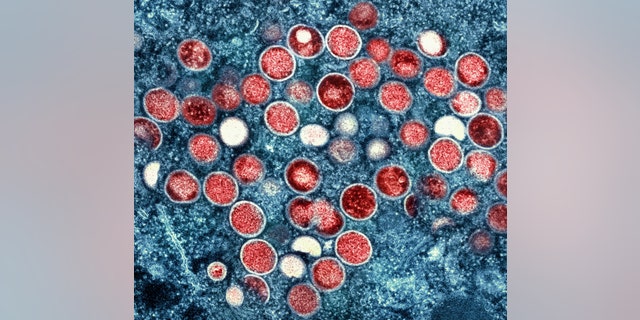
This file image provided by the National Institute of Allergy and Infectious Diseases (NIAID) shows a colored transmission electron micrograph of monkeypox particles (red) found within an infected cell (blue), which was cultured in the laboratory and It was color-enhanced. NIAID Integrated Research Facility (IRF) in Fort Detrick, Maryland.
(NIAID via AP, FILE)
Wear a mask if within six feet of that person; Do not share silverware or cups; Do not touch the person’s sheets, blankets, towels or clothing.
If you touch any of these things, you should wash your hands with soap and water or use an alcohol-based hand sanitizer.
Click here to sign up for our Lifestyle News
If you suspect you have monkeypox, the CDC recommends the following tips: Wear a mask and cover wounds with bandages; Avoid touching others and follow healthcare provider’s recommendations; Wash your hands frequently and avoid touching your eyes; Wear glasses instead of contact lenses; Stay away from others until your rash has healed, all the scab has fallen off and a new layer of intact skin has formed.
Click here to get Fox News App
In addition, it is wise to clean and disinfect the areas frequently.
Also, avoid contact with pets and people who are more likely to get very sick, such as children under the age of 8, pregnant people, and people who have weakened immune systems or certain skin conditions. .
(This story has not been edited by seemayo staff and is published from a rss feed)